May 11, 2026
When cash flow pressure increases, most businesses respond the same way: they hire more people.
More analysts. More collections staff. More manual reporting.
But adding headcount to inefficient processes doesn’t solve the problem — it scales the inefficiency.
In many cases, the real issue isn’t capacity. It’s visibility.
Without clear visibility into receivables performance, payment behaviour, disputes, and cash flow risk, finance teams are forced to operate reactively — no matter how many people are involved.
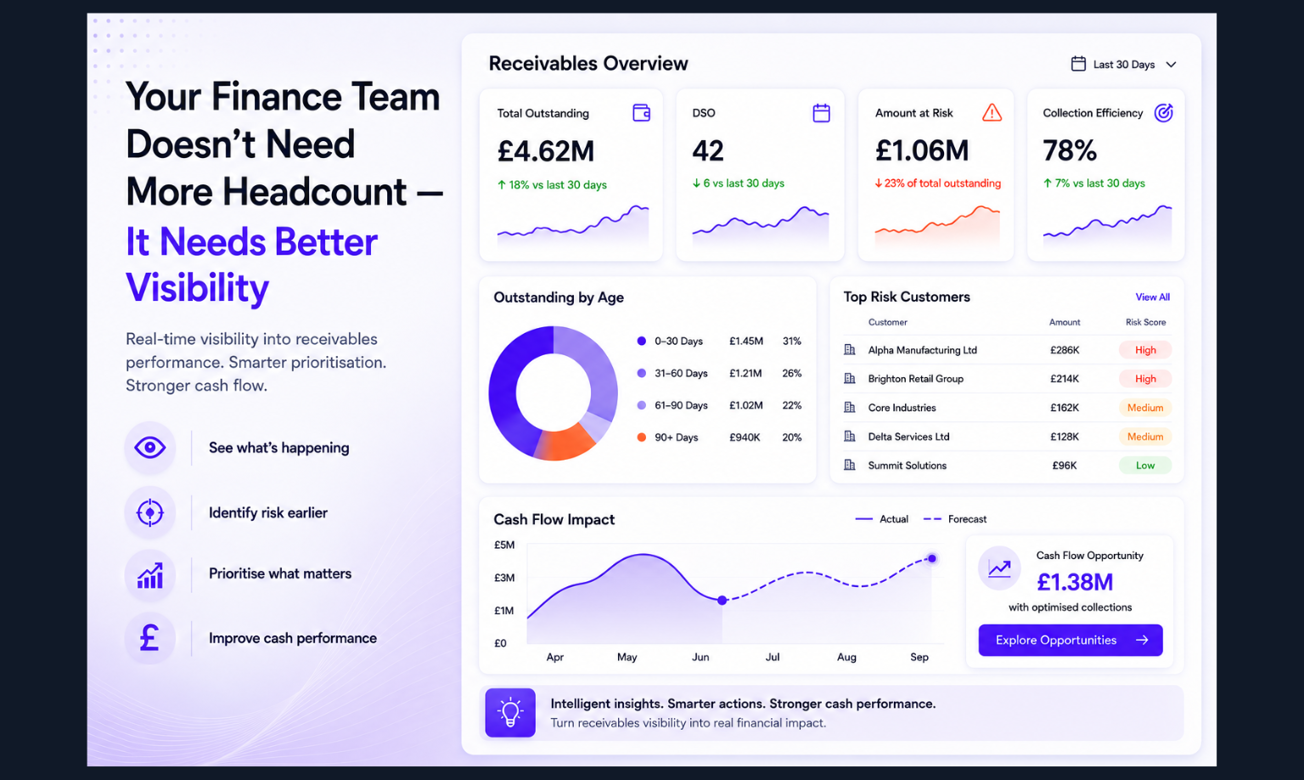
Modern finance teams are expected to:
But many are still relying on:
As transaction volumes increase, these processes become harder to manage.
The result: Teams work harder, but performance doesn’t improve.
Most finance teams already have data.
What they lack is:
Without connected visibility, finance teams struggle to:
This creates reactive workflows that slow down decision-making and reduce operational efficiency.
Adding more people to inefficient processes only increases complexity.
Manual accounts receivable processes create:
As businesses scale, these inefficiencies grow faster than teams can manage them.
This often leads to rising Days Sales Outstanding (DSO) and slower cash conversion.
Lack of visibility impacts more than productivity.
It directly affects:
Without clear receivables visibility:
Over time, these inefficiencies create increasing pressure across finance operations.
With connected receivables visibility, finance teams can:
This shifts accounts receivable from reactive administration to proactive financial operations.
Businesses looking to improve collections efficiency often focus on how to reduce DSO through better visibility and operational optimisation.
High-performing finance teams use connected systems that provide:
Instead of relying on static reports, they operate with live operational intelligence.
This enables teams to identify issues before they affect liquidity.
Modern finance teams are increasingly using AI in accounts receivable to improve operational visibility and collections prioritisation.
AI enables businesses to:
This allows finance teams to move from reactive reporting to proactive receivables optimisation.
Businesses experiencing rising payment delays often first notice the impact through increasing Days Sales Outstanding (DSO) and reduced working capital visibility.
Many businesses focus heavily on profitability metrics like Accounting Rate of Return (ARR).
But profitability metrics do not reflect how efficiently revenue converts into cash.
You can have:
And still experience cash flow pressure.
This is why receivables performance matters.
The best finance teams are no longer focused purely on processing transactions.
They are focused on:
Visibility is what makes this possible.
Businesses with strong receivables visibility can:
Those without it remain trapped in reactive operations and disconnected processes.
Visibility helps finance teams identify payment risks earlier, improve collections prioritisation, and strengthen cash flow performance.
AI analyses payment behaviour and receivables data in real time, helping finance teams improve operational efficiency and prioritise actions earlier.
Not necessarily. Without better visibility and connected processes, additional headcount often increases complexity rather than efficiency.
If your finance team feels overwhelmed, the issue may not be workload.
It may be visibility.
The businesses that improve cash performance fastest are not always the ones with the biggest finance teams — they are the ones with the clearest insight into what’s happening across receivables.
If your finance team is still relying on manual processes and disconnected systems, the problem isn’t workload — it’s visibility.
Modern accounts receivable automation powered by AI helps businesses: