May 14, 2026
Most finance teams can see overdue invoices.
But overdue visibility is not the same as operational visibility.
Many teams still struggle to understand where collections activity is slowing down, which accounts need urgent attention, where disputes are delaying payment, and how receivables workflows are impacting cash performance.
That is the receivables blind spot.
And for both scaling mid-market businesses and larger enterprise finance teams, it creates one common problem: receivables management becomes reactive by default.
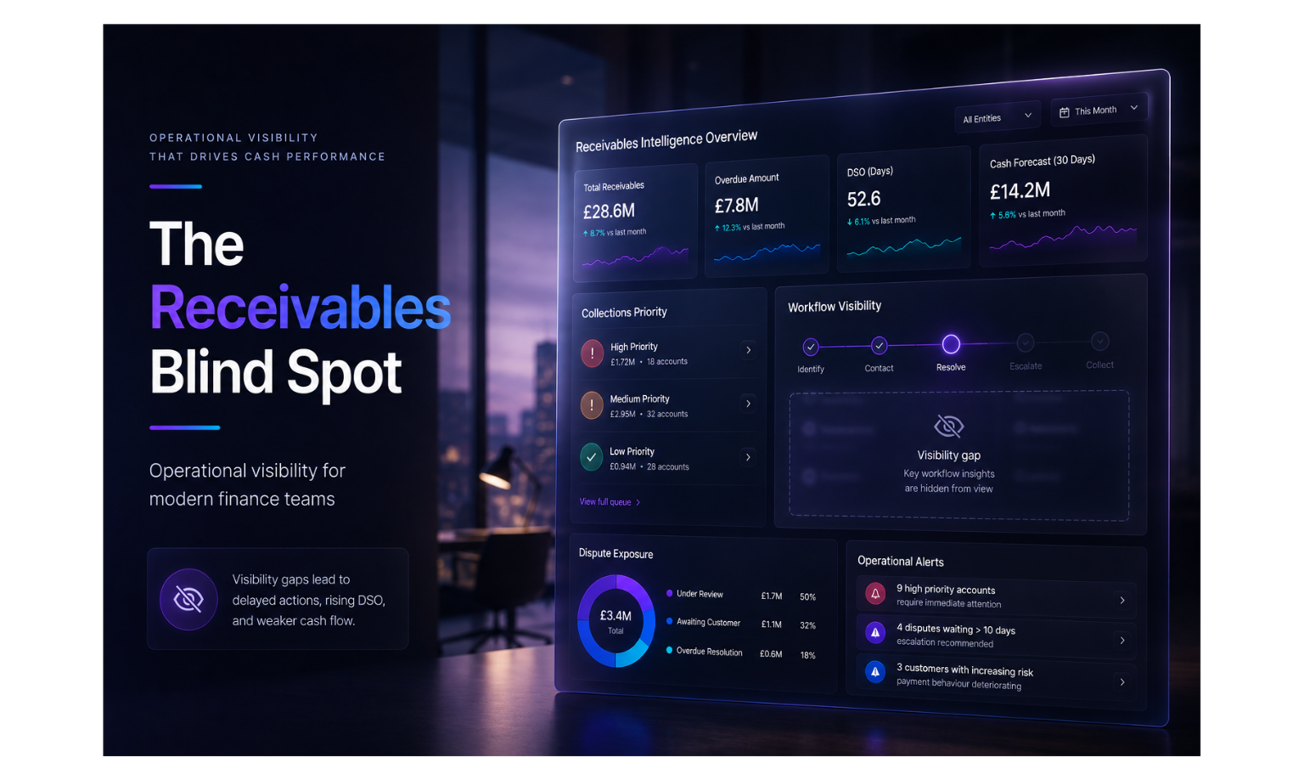
Ageing reports, ERP exports, and overdue balance summaries give finance teams a view of what has already happened.
They show:
But they rarely show what finance teams need to act on next.
That creates a gap between financial reporting and operational control.
Many businesses already follow proven approaches to improve accounts receivable processes, but operational visibility remains a major challenge as finance operations scale.
The receivables blind spot usually sits between systems, teams, and workflows.
It appears when finance teams cannot easily see:
The issue is not simply a lack of data.
It is a lack of usable receivables intelligence.
Without visibility into customer payment behaviour and credit risk, finance teams often struggle to prioritise collections activity effectively.
When teams cannot see what is happening operationally, collections performance becomes harder to manage.
This can lead to:
For mid-market teams, this often creates scaling pressure.
For enterprise teams, it creates complexity across larger customer bases, regions, teams, and systems.
The problem looks different by size, but the operational challenge is the same.
In many organisations, disconnected workflows and inconsistent credit control processes contribute directly to delayed collections performance.
Traditional receivables reporting explains what happened.
Modern receivables visibility helps finance teams decide what to do next.
That distinction matters.
Finance teams do not just need more dashboards. They need operational insight that helps them prioritise activity, coordinate teams, identify risk, and improve cash performance.
This becomes increasingly important as collections workflows become more complex across customers, teams, and systems.
A modern receivables operation gives teams visibility into:
This creates a more proactive way to manage receivables.
Instead of reacting to overdue balances, finance teams can focus attention where it will have the greatest operational and financial impact.
The strongest finance teams increasingly combine operational visibility with structured accounts receivable best practices to create more scalable collections processes.
Invevo gives finance teams the operational visibility needed to manage receivables more intelligently.
As a receivables intelligence platform, Invevo helps teams bring together customer data, collections activity, workflows, and performance insight in one place.
That enables finance teams to:
The result is a more connected, scalable, and proactive receivables operation.
The receivables blind spot is the gap between knowing which invoices are overdue and understanding what is happening across collections workflows, disputes, customer behaviour, and operational performance.
Ageing reports show overdue balances, but they do not explain which accounts need action, where workflows are stuck, or how collections activity is affecting cash performance.
Better receivables visibility helps finance teams prioritise the right accounts, act earlier, resolve bottlenecks faster, and manage collections more consistently.
No. Mid-market finance teams also need stronger visibility as customer volumes, teams, systems, and cash flow pressures grow.
A receivables intelligence platform helps finance teams connect data, workflows, customer insight, and collections activity so they can manage receivables more proactively.
See how Invevo helps finance teams move from reactive collections to operational receivables intelligence.